Source: Sunnen official website https://www.sunnen.com/
Honing machines for India · SUNNEN
Bore finishing from 3 mm boresto 13 m tubes, from one supplier
Sunnen builds vertical, horizontal and tube honing machines, plus skiving and roller burnishing and deep hole drilling, together with the tooling, abrasives, gages and honing fluids that run in them. Sunnen India Pvt. Ltd. is based at Koparkhairne, Navi Mumbai, and is described as a technology centre in Mumbai with over 25 years of experience covering honing and BTA drilling. The commissioning, service and spare-parts scope still needs to be agreed project by project.
What an Indian manufacturer should know first
The published machine list runs from 3 mm bores on vertical machines to tubes of 1,200 mm diameter and 13,000 mm bore length. Scope the enquiry by the part, not by a machine name.
Voltage and frequency differ by model. 220 V 50 Hz, 230 V 60 Hz, 400 V 50 Hz, 460 V and 480 V 60 Hz all appear in the published options, so confirm what is quoted for a 50 Hz Indian site.
Machine warranty is three years or 6,000 spindle hours, whichever comes first. Tooling, gages, fixtures and automation are covered for one year.
Support and replacement parts continue for years after a model is discontinued, though no specific number of years is published — get the supply commitment in writing.
For hydraulic cylinder tubes, skiving and roller burnishing (SHDS) is a separate route published as up to 70% faster than traditional honing. Compare it before defaulting to a tube hone.
Sunnen India supplies machines together with tooling, abrasives, gages, honing fluids and repair parts. Price the consumables over the machine life, not the machine alone.
When should an Indian plant shortlist Sunnen?
The bore is the reason to look here. Sunnen's range is built around parts where size, roundness, straightness and surface texture all have to hold at once, and where the result cannot depend on who is running the machine that shift.
A stronger match when...
The bore is the functional surface: hydraulic cylinders, pump bores, injector bodies, connecting rods, gears, aerospace pins.
A part carries several bores and measuring after every pass has become the throughput limit.
Long tubes or large diameters put the work beyond a general-purpose machine.
Manual honing currently sets the cycle time and the scrap rate.
Tooling, abrasives, gages and honing fluid should come from the same source as the machine.
Existing cylinders or actuators are reconditioned rather than made new.
Confirm carefully when...
The quoted build is a 60 Hz configuration and the plant supply is 50 Hz.
The bore range depends on which tooling family is fitted, as it does on the SH-6000.
Footprint, machine weight, floor loading and coolant volume are not published for the model under discussion.
In-process gaging, size control and SPC output form part of the acceptance criteria.
A cycle time or Cpk figure has not yet been demonstrated on the actual component.
Commissioning, operator training and process trials need to happen in India rather than overseas.
Device capabilities and manufacturer support requirements vary from business to business, differing for precision components, large components and heavy industry, and component repair and processing.
We have carefully selected the honing machines that are best suited to companies based on the features and challenges of their varied businesses, freeing them from needing to rely on specific operators. Please use the information on this site in your comparisons and deliberations.
The published machine list holds 27 products. Narrow the choice by bore size, part length, handling and changeover pattern first, then compare configurations inside that family.
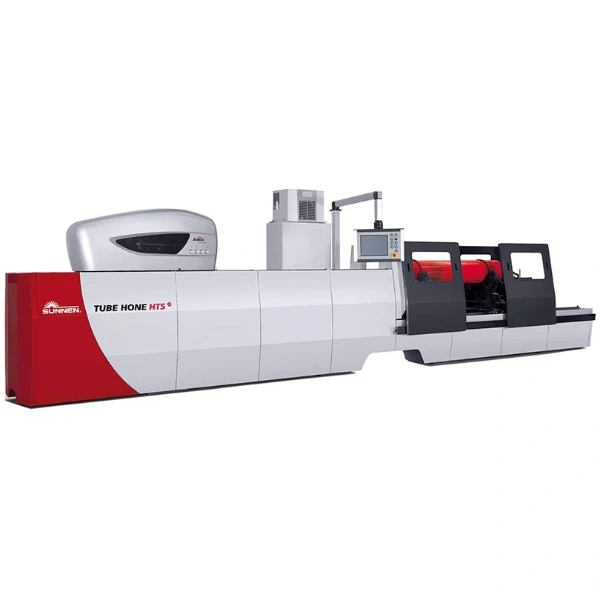
HTA: 64–533 mm ID, 2.1 / 4.1 / 6.1 m stroke HTS: up to 1,200 mm diameter, honing length 2–13 m by model Family also lists HTB, HTC, HTD, HTE, HTG, HTH
Hydraulic cylinder tubes, long tubes and actuator repair or resurfacing work
Honing length increment, foundation and trench, crane and tube support, coolant volume, swarf handling
Skiving and roller burnishing (SHDS)
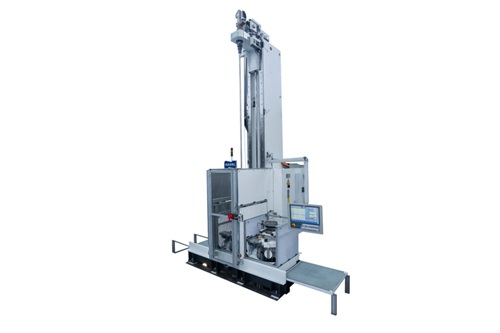
50–178 mm ID in mild steel, OD up to 300 mm Part length 2 m, 4 m or 6 m Spindle up to 1,650 rpm
High-volume hydraulic cylinder tube production where honing time is the bottleneck
Material and hardness against the published mild-steel range, surface specification, 3,765 L coolant system layout
Deep hole drilling (SHDD)
Solid drill 19–127 mm ID in mild steel, OD up to 508 mm Part length 2 m, 4 m or 6 m 400 VAC 50 Hz or 480 VAC 60 Hz
Plants that drill and finish the same bore and want both routes from one supplier
Drilling range against tube specification, and whether the drilling and finishing steps are quoted together
Other listed machine groups
HES external honing, VSS-2 single stroke honing, SVL-2115 vertical lapping, SSH-1680 power stroked honing
External surfaces, lapping and single-stroke work that sits outside standard bore honing
Ranges are issued per model rather than as a family figure; request the data sheet for the specific machine
A published range is not confirmation that a specific part can be processed. Material, hardness, heat treatment, coating, bore interruptions, stock allowance, required form accuracy, surface texture and tooling all change the practical limit.
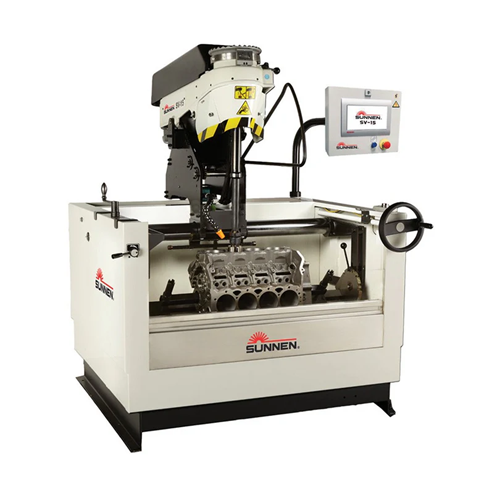
SV-15 Series SV15CD: medium and large bores with a live bore profile
The operator sees the bore while it is being cut. A full bore profile is projected on the touch screen in real time, so taper and out-of-round are corrected inside the cycle instead of being discovered at inspection.
The machine holds size, roundness, straightness and surface finish to OEM specifications by correcting form as it cuts. Up to 100 set-ups can be stored with USB backup, which keeps a repeat job from being re-dialled by hand. Tooling runs either the DH-Series diamond honing tool or existing CK and CV tooling, so a plant already holding Sunnen tooling does not necessarily start from zero.
Bore diameter19–203 mm (tooling dependent)
Part lengthUp to 279 mm
Spindle speed90–350 rpm
Spindle power2.25 kW
Control229 mm touch screen, 100 stored set-ups
Supply (by variant)230 V 60 Hz or 220 V 50 Hz, 3 phase
Three variants are published, all with CE guarding: SV15CD (230 V 60 Hz, inch units), SV15CDM (230 V 60 Hz, metric units) and SV15CFM (220 V 50 Hz, metric units). Longer parts need special tooling. Stroke length, machine dimensions and weight are not published, so request them before fixing the cell layout.
SH-6000: small and medium bores where changeover sets the cost
The bore range moves with the tooling, not the machine. Published ranges are CGT 5.46–32 mm, TC 25.4–75 mm, SRT 39.40–76.78 mm and CRT 53.84–63.75 mm, so a high-mix plant should map every part number to a tooling family before comparing machines.
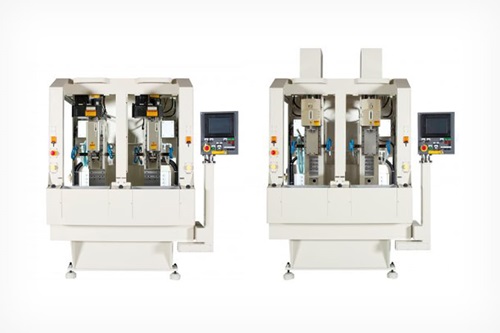
CGT tooling connects directly to the spindle, which removes a set-up step every time the job changes. A servo spindle and ball screw stroker hold bore size control to 0.00025 mm across diamond-plated and metal-bonded abrasive tooling. Six configurations are published — SH6000, SH6000L, SH6000R, SH6000HT, SH6000HTL and SH6000HTR — differing by spindle type and by whether the electrical enclosure sits at the rear or the side.
Bore diameter5.46–76.78 mm across tooling families
Sunnen publishes the SRT and CRT ranges in both metric and inch units and the two do not convert to the same figure, so confirm the exact upper limit for the tooling being quoted rather than working from 76.78 mm. Enclosure side affects how the machine drops into an existing line, so fix the L or R variant against the cell drawing rather than after delivery. Machine dimensions, weight and part length are not published; request them with the quotation.
HTS Series HTS074020 and up: long tubes and large diameters
Honing length is chosen at order, not fixed for life. The range runs from HTS074020 at 2 m with a 7 kW spindle to HTS124130 at 13 m with a 12 kW spindle, and the system can be extended later by a further 4 m or 6 m of honing length, so a tube line can start shorter than its eventual capacity.
Automatic geometry correction with stone wear compensation
Stock removal runs at up to 1,600 cm³/h with full and short stroke repeatable within 0.1 mm. Automatic bore geometry correction, Sizelock and stone wear compensation, dwell, oscillation and spark-out keep the result steady across a long production run, and the machine is published as offering 100% process control with tool overload protection. Set-up on the touch screen is published as achievable within two minutes.
Maximum diameter1,200 mm
Bore length by model2 m to 13 m (13 m on HTS124130)
Stock removal rateUp to 1,600 cm³/h
Stroke repeatabilityWithin 0.1 mm
Spindle power7 kW to 7.5 m; 12 kW to 13 m
Electrical supply460 VAC, 3 phase
The model code carries the spindle and the honing length: HTS074020 is the 2 m, 7 kW build, and the 9.5 m, 10.5 m and 13 m lengths are published only with the 12 kW spindle. Confirm which build sits behind the quotation. A long machine also brings foundation work, tube support, crane access, coolant volume and swarf handling into the purchase decision — plan those with the honing length, not after it.
Power supply and site preparation for an Indian installation
India runs at 50 Hz, and several published Sunnen configurations are 60 Hz builds. This is the single most common item to settle before a quotation is signed, because it decides whether a transformer or a different machine variant belongs in the budget.
Published electrical supply by machine
Machine
Published supply
What to settle for a 50 Hz site
SV-15 (SV15CD / CDM / CFM)
230 V 60 Hz 3 phase (CD, CDM) 220 V 50 Hz 3 phase (CFM)
CFM is the published 50 Hz variant. Confirm which variant is quoted and whether units are inch or metric.
SH-6000
400 VAC or 460 VAC
Confirm the frequency of the build and the enclosure position, then check the incoming panel rating.
HTS tube honing
460 VAC 3 phase
Plan for a transformer and confirm connected load against the 7 kW or 12 kW spindle chosen.
HTA tube honing
400 V 50 Hz or 460 V 60 Hz
A 50 Hz option is published. Confirm it is the option being priced.
SV-3000 (SV3015)
400 / 460 V, 50 / 60 Hz
Confirm the spindle and stroker motor load, since both are rated above 6 kW.
Beyond the supply, these items decide whether the machine can actually be installed and run on the intended shop floor.
Footprint and floor loading: dimensions and weight are not published for several models. Request general arrangement drawings before allocating floor space.
Coolant and filtration: published tank volumes range from 208 L on the SH-6000 to a 3,765 L modular system on the SHDS. Sump, top-up, filtration and disposal all follow from that number.
Swarf and sludge: honing produces fine abrasive-laden sludge. Agree the separation method and disposal route with the plant's environmental clearance conditions.
Handling: tube machines need crane capacity, tube support and a loading route into the building. Confirm these against the longest tube in the production plan.
Guarding and sign-off: CE guarding is published on the SV-15 variants and on the SHDS. Confirm how that documentation maps to the plant's own safety approval process.
Ambient conditions: agree the temperature and humidity assumptions used for the size-control figures, since bore tolerances in the sub-micron range are sensitive to both.
Treat this as a preparation checklist, not a substitute for a site survey by the supplier.
Two published cases where the honing route changed the result
Both cases come from aerospace work on SV-1000 and SV-1015 machines, which are not on Sunnen's current published machine list. Use them to understand what the process change achieved, and ask which current model covers the same application.
Machine: SV-1015
User: Waltz Brothers, Inc.
Part: aerospace hydraulic pump body
Before
Nine bores in a single flight-critical pump body each had to hold micron-level tolerances. On a standard honing machine that takes great skill and many time-consuming machine-and-measure iterations, with nine chances per part to lose an expensive workpiece.
After
The SV-1015 removed the measure-and-adjust loop between passes, so the same nine bores came out to the same size shift after shift.
Nine bores per part at 0.000020 in (0.5 µm) variation and a process capability of 2.21 Cpk, with essentially no operator attention. Their customer was impressed enough to ask them to commit to a five-year blanket order for all of those parts.
Fuse pins hold a jet engine to the wing and are designed to shear in an emergency, so the bore carried a 5-to-7 micron ID tolerance plus a specified finish. Manual honing capped both the cycle time and the daily output.
After
CNC control replaced operator judgment on feed and stroke, so the tolerance and finish were repeated part after part rather than recovered by rework.
Cycle time fell from 40 minutes to 10 minutes per part, a 75% reduction, and output rose from 9 parts per day to 40.
These are application-specific results on specific machines. They do not establish an achievable figure for another part, material, tolerance, volume or machine configuration.
Warranty, spare parts and training scope
The warranty splits in two, and the shorter half covers the items that wear fastest.
Machine warranty: three years or 6,000 spindle hours on base machines and factory-installed options, whichever comes first.
One-year items: custom fixtures, automation, tooling, gages and accessories. Build a consumable and tooling budget for the first two years rather than assuming the machine warranty covers them.
Spare parts: support and replacement parts continue for years after a model is discontinued, which protects a long-life asset.
Field service: technicians provide on-site troubleshooting and repair for Sunnen products worldwide.
Training: on-site training is provided at installation, with customised programmes covering machine operation, tooling integration and coolant application for new operators or new applications.
Application engineering: honing procedures for new applications are developed and validated at Sunnen's Advanced Technology Center before deployment.
Technology centre with over 25 years of experience, covering honing and BTA drilling machines and tools, abrasives, tooling, gages, honing fluids and coolants, and repair parts
Which installation, commissioning and acceptance activities are carried out by engineers based in India?
What are the target response and site-visit times for the plant's location?
Which honing tools, abrasives, gages and critical machine spares are held in stock in India?
Can process trials on the actual component be run in Navi Mumbai, or do parts have to be shipped to the Advanced Technology Center?
What operator, maintenance and troubleshooting training is included at installation, and in which language?
How are warranty work, preventive maintenance and annual maintenance contracts priced and scheduled?
Which honing fluid is specified, and is it supplied locally or imported?
If remote support is used, what network connection and data-access approval does it require?
Information to prepare for a Sunnen honing-machine enquiry
Start from the bore, the required result and the production conditions. A machine name alone leaves the tooling, abrasive specification, gaging method and cycle time unresolved, and those decide the cost per part.
Part drawing, bore geometry, number of bores per part, datum system and clamping surfaces
Material, hardness, heat treatment and any coating or plating in the bore
Incoming bore size, stock allowance and the variation seen in the previous operation
Final bore diameter and dimensional tolerance
Roundness, cylindricity, straightness and perpendicularity requirements
Surface roughness, crosshatch angle and the measurement method used to prove them
Monthly volume, batch size, shift pattern and target cycle time
Gaging, in-process size control, SPC output and required capability index
Loading method: manual, robot, pallet or integration into an existing line
Floor space, building height, foundation, crane capacity and the route into the building
Plant supply voltage and frequency, coolant provision, filtration and disposal arrangements
Acceptance criteria, capability study and the inspection records required at handover
For tube honing or skiving enquiries, add total tube weight, unsupported length, wall thickness, incoming straightness, lifting points and any internal obstruction.
[Advertisement] Top Three Honing Machines That Free You from Reliance on Individual Operators
BS-VI standards and growing EV demand are driving unprecedented needs for precision machining.
While the "overseas components + local assembly" model keeps initial costs low, design mismatches and unclear accountability create long-term risks.
Integrated management from design to assembly ensures consistent machining accuracy regardless of operator, minimizing material loss, accelerating ROI, and building the foundation for global trust.
Advertiser Disclosure:
We receive compensation from some of the companies listed below.This compensation may affect which companies are included and the order in which they appear.
For precision component suppliers
G Series NISSIN ProSOL
Source: NISSIN ProSOL official website https://mktg.nissin-mfg.co.jp/product/gseries/
This honing machine synchronizes stroke and stone expansion in 0.01 μm increments, enabling precision honing of holes as small as 3 mm in diameter and 80 mm deep, even in hard materials.
Automatic electronic control and made-to-order jigs reproduce the techniques of veteran operators.
These honing machines eliminate deviations in the manufacturing of precision components such as control valves while also reducing personnel costs.
Source: Nagel official website https://nagel.com/en/products/honing/honing-machines/tube/
Machine height can be reduced through pit installation, reducing the footprint and using less volumetric space. It also makes it easy to mount and unmounts heavy objects such as engine blocks, reducing the operation workload.
They can even cut the large machining allowances unique to heavy industry in short amounts of time.
Bore Diameter
~⌀350
Workpiece Length
3,800mm
Spindle Stroke Length
Not specified on official website
Main Applications
Long pipes and tubes / Piston rods / Heavy workpieces / Exterior diameter processing, etc.
Source: Sunnen official website https://sunnen.com/products/sv-15-vertical-honing-machine
A graph showing the status of the hole being honed is displayed on-screen, in real time. This makes it easy to visually understand where the workpiece is and how it is warped, accelerating repair decisions.
These systems can store up to 100 processing settings at any time. They can also be backed up via USB, so even for small-lot, high-mix jobs, you can instantly reproduce the same processing as in previous jobs. They also shorten set-up times.