
Advanced Honing Navigator │ Choose the Ideal Honing Machine » What is honing machine » Honing Machine Price
Honing Machine Price
Contents
show more
The Indian government is implementing policies for making its manufacturing industry more competitive and improving the positions of global value chains.※ A greater focus is being placed on capital investment, including quality consistency and maintenance systems.
This article presents approximate prices of honing machines and explains why buying machines from overseas manufacturers through official sales channels may have a higher initial cost, but it’s the better choice in the long run.
* Source: [PDF] Government of India Press Information Bureau (PIB) (https://static.pib.gov.in/WriteReadData/specificdocs/documents/2025/sep/doc2025919640901.pdf)
Price ranges for different types of honing machines
The prices of honing machines vary significantly depending on their level of automation and their precision accuracy. Below are the general price ranges of honing machines for each machine type and grade.
Hydraulic honing machines
| Class | Price range (Rupees) |
|---|---|
| Low-end | Approx. 98,000 to 150,000 |
| Mid-range | Approx. 150,000 to 850,000 |
| High-end | Approx. 2,200,000 to 4,000,000 or more |
Source: IndiaMART website (https://dir.indiamart.com/impcat/hydraulic-honing-machine.html)
* Investigated and analyzed using AI based on price information for honing machines posted on IndiaMART (as of March 9, 2026, Area: Mumbai)
Low-end hydraulic honing machines consist primarily of one or two horsepower manual or semi-automatic models. They tend to be used for basic applications. Mid-range machines tend to be two to five horsepower, fully-automated general-purpose models. In our study, some high-end models were industrial models with outputs between 5 and 15 horsepower and support for CNC control and cylinder processing for construction machinery.
Horizontal honing machines
| Class | Price range (Rupees) |
|---|---|
| Low-end | Approx. 60,000 to 175,000 |
| Mid-range | Approx. 300,000 to 1,000,000 |
| High-end | Approx. 1,500,000 to 5,000,000 |
Source: IndiaMART website (https://dir.indiamart.com/impcat/horizontal-honing-machines.html)
* Investigated and analyzed using AI based on price information for honing machines posted on IndiaMART (as of March 9, 2026, Area: Mumbai)
Low-end horizontal honing machines are primarily compact, hand-operated machines or used machines from overseas manufacturers (sold through unofficial channels) with limited functionality. Mid-range models are primarily semiautomatic models with one to three horsepower. These standard models have functions such as auto stroke count functions. High-end models include large dedicated tube processing models that are fully automated and have CNC functions. Their designs are often matched to the needs of mass production sites.
CNC vertical honing machines
| Class | Price range (Rupees) |
|---|---|
| Low-end | Approx. 70,000 to 250,000 |
| Mid-range | Approx. 340,000 to 950,000 |
| High-end | Approx. 2,000,000 to 4,700,000 |
Source: IndiaMART website (https://dir.indiamart.com/impcat/vertical-honing-machines.html)
* Investigated and analyzed using AI based on price information for honing machines posted on IndiaMART (as of March 9, 2026, Area: Mumbai)
Low-end CNC vertical honing machines include some machines that purport to be CNC models but are actually manual or semi-automatic, so extra close attention is needed when deploying a low-end CNC vertical honing machine. Mid-range models are primarily two to three horsepower semi-automatic to fully-automatic devices with auto stroke functions. High-end devices include advanced PLC/CNC machines and high-performance models with micron-level high-precision processing capabilities.
Cylinder honing machines
| Class | Price range (Rupees) |
|---|---|
| Low-end | Approx. 70,000 to 130,000 |
| Mid-range | Approx. 150,000 to 450,000 |
| High-end | Approx. 2,000,000 to 3,000,000 or more |
Source: IndiaMART website (https://dir.indiamart.com/impcat/cylinder-honing-machine.html)
* Investigated and analyzed using AI based on price information for honing machines posted on IndiaMART (as of March 9, 2026, Area: Mumbai)
Low-end cylinder honing machines are one or two horsepower manual or semi-automatic machines used for small-scale processing such as motorcycle cylinder processing. Mid-range machines include models that can be used for automobile engine blocks and portable devices that can handle both boring and honing. High-end machines include automatic CNC machines capable of high-precision processing on large components or large cylinders.
Factors that affect honing machine price
The prices of honing machines vary significantly depending on the sizes of workpieces, the level of precision that’s needed, and how automated they are. Below, we’ve summarized the reasons that each of these affect machine price.
Workpiece
The larger and deeper the hole to be honed, the larger the machine used for honing needs to be, which raises the machine’s price. Furthermore, the machines that are used to process hard materials must themselves be sturdy (resistant to deformation), so these machines tend to be more expensive for models used to process common materials.
Required precision
When striving for micron-level circularity or cylindricality, you need a machine with a precise spindle mechanism and fine-tuning functions to produce consistent quality. This requires a high level of precision in the processing and assembly of the machine’s components, which drives the price up.
Automation level
Machines may have devices for automatically mounting and unmounting workpieces, in-process measurement functions for measuring dimensions in real time, correction functions that automatically adjust honing stone expansion. These all require advanced sensors and control systems. While they may contribute to labor savings, they have higher initial investments.
Production cycle time
To shorten the processing time per workpiece, machines require higher stroke speeds for their spindles or multiple spindles for processing multiple workpieces at the same time. This makes their internal structures more complex and requires more powerful programs, so the faster the mass production-specialized model, the higher the price tends to be.
Special options
Coolant temperature management devices are essential for maintaining processing stability. Oil mist removers keep environments clean. Vibration-proof structures shut out external vibrations. Honing machines have many special options like these, which are not included standard. The more of these special options are added, the more expensive the machine will be.
Machine sturdiness and durability
Another factor that leads to prices differences is the sturdiness of beds, spindles, and other components. Solid construction that prevents vibration and thermal deformation during processing uses a large amount of high-quality cast iron, driving material prices up. In addition, these machines require additional workloads for advanced structural analysis and the processing of the components they use, so their construction costs are also higher than lower-cost machines.
What kinds of return can you expect from investing in honing machines?
If you choose a honing machine based purely on its low initial cost, you may find that it’s disadvantageous in the long run. You need to look at the true overall return on your investment, such as running costs after installation or reductions to defect rates that the machine will make possible.
Reducing defect rates
Machines from overseas manufacturers, with advanced automatic measurement functions, correction functions, and the like, acquired via proper sales channels, contribute to greater dimensional stability and yields. By reducing the amount of overcutting and dimensional error that happens with manual work, you can reduce the amount of material loss. This will likely produce enough value that it makes up for any differences in initial costs.
Labor cost reductions
Replacing the intuition and manual work of experienced operators with advanced automatic machines helps cut back on constantly rising personnel costs. Honing machines make it easier for even inexperienced operators to perform consistently high-quality processing, which helps with work standardization.
Downtime prevention
When cheap systems stop working due to sudden malfunctions, shutting down production, it has a major impact on worksites. Not only does arranging for substitute equipment and performing emergency repairs take a lot of effort, but it can also directly cause delivery delays and cause customers to lose their trust in you. Choosing a machine from an overseas manufacturer, sold via official channels, that provides extensive and dependable support helps ensure that your production will be free of interruption.
Freeing yourself from jugaad and thinking in terms of total cost
Domestic manufacturers primarily offer low-end and mid-range models. While used machines from overseas manufacturers (purchased through unofficial channels) are inexpensive, they don’t offer manufacturer warranties, so when they malfunction, the cost of dealing with the problem is high. If you want to focus on performance while keeping down total costs, the smart choice is to avoid the jugaad (makeshift stop-gap) mentality and instead purchase a high-end machine from an overseas manufacturer via an official sales channel.
Device capabilities and manufacturer support requirements vary from business to business, differing for precision components, large components and heavy industry, and component repair and processing.
We have carefully selected the honing machines that are best suited to companies based on the features and challenges of their varied businesses, freeing them from needing to rely on specific operators. Please use the information on this site in your comparisons and deliberations.
Top Three Honing Machines
That Free You from Reliance on Individual Operators
That Free You from Reliance on Individual Operators
BS-VI standards and growing EV demand are driving unprecedented needs for precision machining.
While the "overseas components + local assembly" model keeps initial costs low, design mismatches and unclear accountability create long-term risks.
Integrated management from design to assembly ensures consistent machining accuracy regardless of operator, minimizing material loss, accelerating ROI, and building the foundation for global trust.
For
precision component suppliers
precision component suppliers
G Series
NISSIN ProSOL
NISSIN ProSOL
Source: NISSIN ProSOL official website https://mktg.nissin-mfg.co.jp/product/gseries/
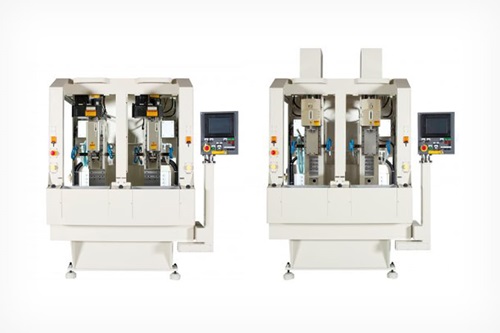
This honing machine synchronizes stroke and stone expansion in 0.01 μm increments, enabling precision honing of holes as small as 3 mm in diameter and 80 mm deep, even in hard materials.
Automatic electronic control and made-to-order jigs reproduce the techniques of veteran operators.
These honing machines eliminate deviations in the manufacturing of precision components such as control valves while also reducing personnel costs.
| Bore Diameter |
⌀3~⌀100 |
|---|---|
| Workpiece Length |
130mm |
| Spindle Stroke Length |
Max. 300mm |
Main Applications
Gears / Connecting rods / Hydraulic valves, etc.
For
large components and heavy industry
large components and heavy industry
VL Series
Nagel
Nagel
Source: Nagel official website https://nagel.com/en/products/honing/honing-machines/tube/
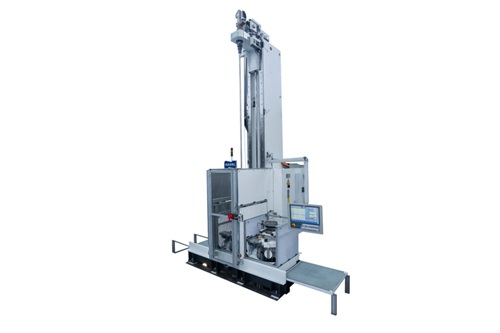
Machine height can be reduced through pit installation, reducing the footprint and using less volumetric space. It also makes it easy to mount and unmounts heavy objects such as engine blocks, reducing the operation workload.
They can even cut the large machining allowances unique to heavy industry in short amounts of time.
| Bore Diameter |
~⌀350 |
|---|---|
| Workpiece Length |
3,800mm |
| Spindle Stroke Length |
Not specified on official website |
Main Applications
Long pipes and tubes / Piston rods / Heavy workpieces / Exterior diameter processing, etc.
For
parts repairs and processing-on-consignment
parts repairs and processing-on-consignment
SV Series
Sunnen
Sunnen
Source: Sunnen official website https://sunnen.com/products/sv-15-vertical-honing-machine
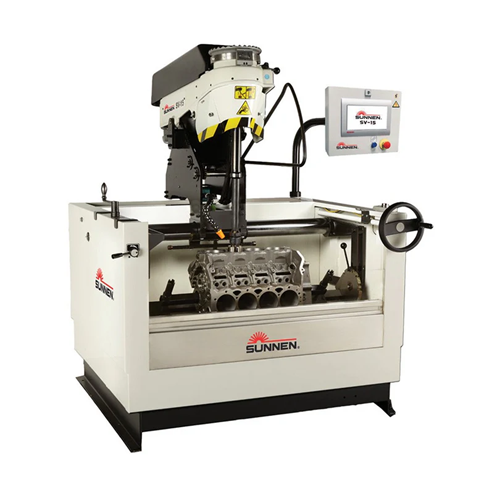
A graph showing the status of the hole being honed is displayed on-screen, in real time. This makes it easy to visually understand where the workpiece is and how it is warped, accelerating repair decisions.
These systems can store up to 100 processing settings at any time. They can also be backed up via USB, so even for small-lot, high-mix jobs, you can instantly reproduce the same processing as in previous jobs. They also shorten set-up times.
| Bore Diameter |
~⌀203 |
|---|---|
| Workpiece Length |
279mm |
| Spindle Stroke Length |
~225mm |
Main Applications
Engine blocks, etc.