Engis Corporation builds single-pass bore finishing machines in Wheeling, Illinois, and designs the diamond-plated tools, fixtures and automation that run on them. Put Engis on the shortlist when valve bodies, pump cylinders or other production parts must hold micron-level size and form, cycle after cycle, with less reliance on operator skill.
What to know first
Engis finishes bores with a series of fixed-size diamond tools, each passing through the bore once, instead of expanding stones that stroke back and forth.
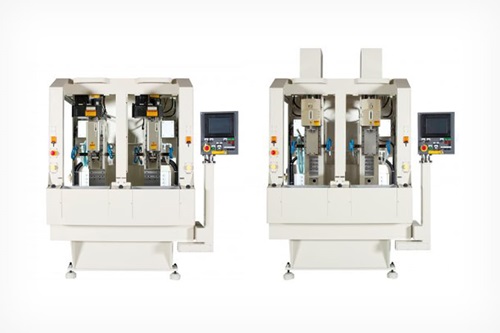
The SPM covers bores up to 50 mm and the LPM up to 152 mm. The FPM-3X and Hybrid machines target stacked valve bodies and high-volume valve bushings.
Published results include 0.0005 mm roundness on a cast-iron valve body and 240 ABS pump cylinders per hour on one machine.
Engis designs the machine, tooling and fixtures in-house and runs pilot parts in its own process development laboratory.
The official locations list shows no India office; the nearest subsidiary is in Singapore, so confirm the service route before ordering.
Is Engis single-pass finishing a fit for your part?
Single-pass finishing pays off when the same bore is produced in volume and its size and geometry must stay inside a narrow band. Use these points to screen the part, then confirm with a pilot run on real workpieces.
A stronger fit when...
The same bore family runs in high volume, so a dedicated tool set stays in use over long runs.
Size, roundness and cylindricity are specified in microns and must be held with a stated Cpk.
Mating parts such as spools and sleeves are sorted into size classes today, and you want to reduce matching.
The part has through, semi-blind, blind or stepped bores.
Bore quality currently depends on a few experienced honing operators.
Confirm carefully when...
Part numbers change often, because each bore size needs its own set of preset tools.
Incoming stock allowance varies widely or is larger than the tool progression is designed to remove.
The bore is longer than three times its diameter, which needs axial and radial float in the tooling or fixture.
The bore is over 152 mm or needs more stroke than the standard machines offer.
Fast on-site service in India is a deciding factor.
How single-pass finishing differs from conventional honing
A conventional honing tool expands and contracts while it reciprocates, so bore size and geometry are controlled at the same time as material is removed. Engis tools are preset to size, and the stock is removed in stages across several spindles on an indexing table.
Conventional honing and Engis single-pass finishing compared
Point
Conventional honing
Engis single-pass
Tool size
Stones expand and contract during the cycle
Each tool is preset to a fixed diameter
Tool motion
Many strokes through the bore
Usually one pass per tool; some geometries need a multi-stroke pattern
Stock removal
One tool removes the full allowance
Several tools share the work, from coarse to fine diamond
Size control
Set by stone expansion and gauging during the cycle
Set by the tool diameter and corrected by adjusting the tool as it wears
Example tool progression for a φ19 mm bore
Tool
Preset diameter
Diamond grit
Role
#1
φ19.000 mm
60/80
Removes most of the stock
#2
φ19.020 mm
100/120
Refines size and geometry
#3
φ19.030 mm
200/230
Approaches final size and finish
#4
φ19.035 mm
325/400
Removes the least stock and sets the final finish
The number of tools depends on the stock to be removed, the surface finish required and the geometry to be corrected. Engis lists shorter cycle times, fewer rejects and less frequent inspection as benefits of spreading the work this way; confirm the cycle time for your part in a pilot run.
Device capabilities and manufacturer support requirements vary from business to business, differing for precision components, large components and heavy industry, and component repair and processing.
We have carefully selected the honing machines that are best suited to companies based on the features and challenges of their varied businesses, freeing them from needing to rely on specific operators. Please use the information on this site in your comparisons and deliberations.
Part weight, fixture design and whether automatic size compensation is included
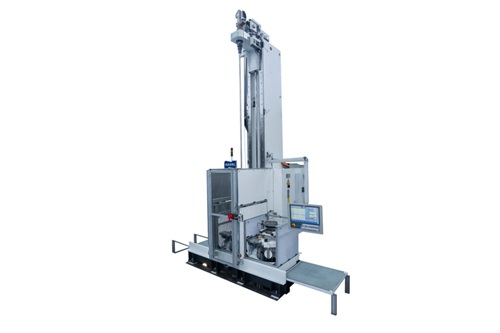
FPM-3X
Diameter range not published 750 mm stroke
Large hydraulic valve bodies finished after stacking, using a tool changer and wireless probe to locate bores
Bore sizes, stack height and the number of tools required
Hybrid
Up to 120 parts/hour Size control within 1 μm
High-volume hydraulic cartridge valves and servo valve bushings needing multi-stroke semi-finishing and single-pass final finishing in one machine
Bore range and cycle time for your specific valve design
Published ranges and rates are selection guides, not confirmation that a specific part can be processed. Material, stock allowance, bore geometry, tooling and gauging conditions change the practical result.
SPM Series: multi-spindle finishing for bores up to 50 mm
The SPM is Engis's standard platform for small and medium parts. It holds up to 10 tools on an indexing table and can process two parts per cycle, which suits lines where takt time and size stability matter more than frequent part changes.
Bore rangeUp to 50 mm (website: up to 51 mm)
Spindles / tools1–10 (website: 4, 6, 8 or 10 spindles)
Stroke (Z-axis)620 mm standard; extended stroke available (website: 457 mm)
ControllerMitsubishi CNC as standard; other controllers available
Gauging and sizingOptional packages, including automatic tool sizing and tool size verification
Machine weight2,000 kg
Power / air380–460 V or 200–240 V, 50/60 Hz, 3-phase · 6.2 bar
Machine dimensionsContact Engis (not stated in the current specification sheet)
Workpiece lengthContact Engis (spindle nose to table: 750 mm standard)
Where the website and the specification sheet differ, the table shows the specification-sheet value first. Ask Engis which values apply to the machine being quoted.
The LPM carries the same single-pass process to heavier parts. Optional automatic tool size compensation uses a servo-controlled precision drawbar on each spindle, so tool wear can be corrected without stopping to reset tools by hand.
Bore rangeUp to 152 mm (6 in)
Spindles / tools4, 6 or 8
Stroke (Z-axis)635 mm standard; extended stroke available
Spindle speed / motor100–1,500 rpm · 7.5 HP standard, up to 15 HP
Parts per cycle2
Dial plate diameter864 mm
Machine weight2,500 kg
Power460 V, 50/60 Hz, 3-phase
Machine dimensionsContact Engis (not stated in the current specification sheet)
Workpiece lengthContact Engis (spindle nose to table: 740 mm standard)
Tooling, gauging and automation behind the machines
Engis makes its own electroplated diamond tools, so the machine, tool progression and fixture are designed together. Engis states that plated tools expose more diamond than bonded stones, giving cooler cutting and better size control.
Tooling options
Blind-bore, flexure and U-joint tools, coolant-through designs and self-adjusting tools.
Tools for bore-to-datum concentricity, OD finishing and seating.
Step-bore tools with two diamond sleeves on one mandrel, each adjusted separately: size within 1 μm, coaxiality down to 1 μm, cylindricity under 2 μm, typically 150–300 parts per hour.
Gauging and automation
Static and dynamic air gauging for bore size, ovality, taper, straightness, concentricity, perpendicularity and parallelism.
SPC calculations and data reporting to the machine, cell or plant network.
Case 2: ABS pump cylinders finished at 240 parts per hour
Industry: automotive brake systems
Machine: six spindles with rotary table
Bore: blind-bore style tooling
Before
The cylinder bore needed a defined texture: valleys to hold oil and a smooth plateau for the piston. Conventional honing could not produce it in mass production with acceptable statistical capability.
After
A customized system split the finish into four stages: 100/120 grit for stock removal, 200/230 grit to form the valleys, 325/400 grit to remove peaks and a fine diamond brush to clear torn and folded debris. Gimbal fixtures and floating tool holders let the tools follow the bore.
Each machine finished 240 parts per hour to the required surface finish, with perishable tool cost under USD 0.03 per part.
Case 3: steering housing held within a 0.7 μm process range
Industry: automotive steering
Material: ductile iron
Tooling: six-tool semi-blind progression
Before
Up to 0.038 mm of stock had to be removed from a semi-blind bore with limited clearance at the bottom, on a heavy housing that was hard to float.
After
The part was held rigid while spring-loaded holders and a pivoting union floated the tools. Six tools ran from 40/50 to 200/230 mesh diamond.
The process held size within a total range of 0.7 μm, including bore shape and gauge variation.
Results depend on the component, material, incoming condition, tooling, fixture, gauging method and plant environment. Agree the acceptance method before the pilot run.
Support for buyers in India: what is established and what to confirm
What is already established
Manufacturing
All bore finishing machines are designed and assembled in Wheeling, Illinois, USA
Nearest subsidiary
Engis Asia Pacific Pte. Ltd., Singapore
India office
None listed on the official locations page
Process testing
A process development laboratory that runs pilot parts for proof of concept
Global coverage
Sales and service offices in North America, East Asia and Europe, plus a distribution network
Confirm these points before issuing a purchase order
Who installs, commissions and services the machine in India, and from which location?
What are the target response and site-visit times for your plant?
How are worn diamond tools replaced or resized, and how long does shipping to India take?
Which spare parts are stocked in Singapore or India, and which ship from the USA?
Where will the pilot run take place, and what measurement report will you receive?
What do the warranty, operator training and the current ISO 9001 certificate cover?
[Advertisement] Top Three Honing Machines That Free You from Reliance on Individual Operators
BS-VI standards and growing EV demand are driving unprecedented needs for precision machining.
While the "overseas components + local assembly" model keeps initial costs low, design mismatches and unclear accountability create long-term risks.
Integrated management from design to assembly ensures consistent machining accuracy regardless of operator, minimizing material loss, accelerating ROI, and building the foundation for global trust.
Advertiser Disclosure:
We receive compensation from some of the companies listed below.This compensation may affect which companies are included and the order in which they appear.
For precision component suppliers
G Series NISSIN ProSOL
Source: NISSIN ProSOL official website https://mktg.nissin-mfg.co.jp/product/gseries/
This honing machine synchronizes stroke and stone expansion in 0.01 μm increments, enabling precision honing of holes as small as 3 mm in diameter and 80 mm deep, even in hard materials.
Automatic electronic control and made-to-order jigs reproduce the techniques of veteran operators.
These honing machines eliminate deviations in the manufacturing of precision components such as control valves while also reducing personnel costs.
Source: Nagel official website https://nagel.com/en/products/honing/honing-machines/tube/
Machine height can be reduced through pit installation, reducing the footprint and using less volumetric space. It also makes it easy to mount and unmounts heavy objects such as engine blocks, reducing the operation workload.
They can even cut the large machining allowances unique to heavy industry in short amounts of time.
Bore Diameter
~⌀350
Workpiece Length
3,800mm
Spindle Stroke Length
Not specified on official website
Main Applications
Long pipes and tubes / Piston rods / Heavy workpieces / Exterior diameter processing, etc.
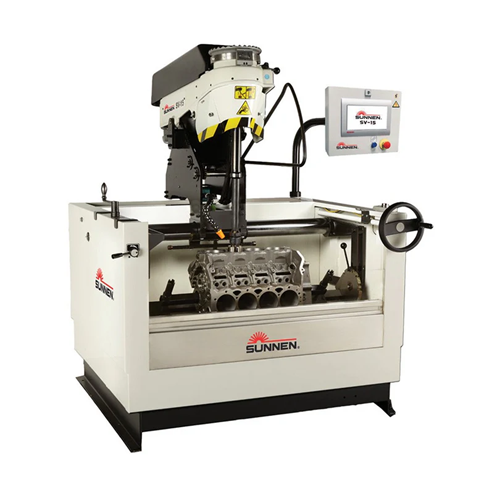
Source: Sunnen official website https://sunnen.com/products/sv-15-vertical-honing-machine
A graph showing the status of the hole being honed is displayed on-screen, in real time. This makes it easy to visually understand where the workpiece is and how it is warped, accelerating repair decisions.
These systems can store up to 100 processing settings at any time. They can also be backed up via USB, so even for small-lot, high-mix jobs, you can instantly reproduce the same processing as in previous jobs. They also shorten set-up times.