
Advanced Honing Navigator │ Choose the Ideal Honing Machine » Types of honing machine » Vertical Honing Machines
Vertical Honing Machines
Contents
show more
This page explains how vertical honing machines work and how to pick them. It also includes a list of vertical honing machines. It can help you select the right machine for you, whether it be for heavy industry or mass production line use.
What are vertical honing machines, and how do they work?
Vertical honing machines are machine tools in which a spindle with an attached honing stone moves reciprocally along a vertical axis, from the ceiling toward the floor and back, to produce holes with high-precision interior diameters in workpieces.
There are two main differences between these machines and horizontal models. The first is that, because gravity pulls straight down, there is little deformation of workpieces or spindles due to their own weight. The second is that the top of the machine is open, so workpieces can be easily loaded and unloaded from above using a crane or gantry loader.
Advantages of using vertical honing machines
Maintaining a high level of circularity by preventing large or heavy components from deforming under their own weight
With horizontal machines, if long or heavy workpieces are mounted horizontally, their middles will sag under their own weight, which results in deformation in the finished hole.
With vertical machines, on the other hand, processing is performed in the same direction as gravity, which helps prevent deformation due to the workpiece's own weight. This helps the machines achieve a high level of circularity and cylindricality even for large engine blocks or long hydraulic cylinders.
High level of compatibility with gantry loaders, compact size, and multi-spindle design
Vertical machines have small footprints, which makes it easy to install multiple machines alongside each other even in limited factory spaces. This is one of their strengths. They are also designed such that workpieces are loaded from directly above, so they can be smoothly integrated with gantry loaders or robot arms. The ease with which transport can be automated also makes it easy to use multiple spindles (for simultaneously performing multiple processes), and they contribute to shorter tact times.
Disadvantages of using vertical honing machines
Machines require high ceilings (overhead spaces) and pits
Not only are vertical machines themselves tall, but they require enough space for a spindle as long as the workpiece to be lifted out. Before installing a vertical honing machine, you need to confirm the height of your ceiling, and in some cases you may need to dig a sub-floor pit.
Main applications of vertical honing machines
Heavy industry and commercial vehicles
Vertical honing machines are suited for use with the large diesel engine blocks used in trucks and buses, large-diameter hydraulic cylinders used in construction machinery, ship components, and other applications involving heavy, long workpieces. In worksites where deformation due to workpiece weight is unacceptable, vertical machines, with their low-deformation structure, help produce higher precision results.
Mass production and automation
Vertical honing machines are also suited for use in lines which handle the mass production of small and medium-sized components, such as motorcycle and automobile connecting rods, pinion gears, and steering components. They can be combined with gantry loaders to eliminate human involvement between processing steps, which can enable you to fully automate workpiece transport.
How to choose a vertical honing machine
When selecting a vertical honing machine, "what you should prioritize" will differ based on the applications of the machine. For large components, the first things you will want to check are the sturdiness of the spindle, the stroke length, and what diameters the machine can work with. For mass production and automation applications, the existence of a connection interface for automation, such as gantry loaders or transfer systems, is also important.
In some cases, voltage and frequency specifications can also have an impact on equipment selection, so we recommend checking power specifications and including manufacturer support systems in India in your comparisons and deliberations.
This site presents a carefully selected list of honing machines available in India, categorized by the business sector they are best suited for, with the aim of eliminating the problem of reliance on the skills of individual operators. It also presents the support systems of each manufacturer, so please use it in your comparison and deliberations.
List of vertical honing machines (for heavy industry or large components)
G Series(Standard Model)「G75 type」

Source: NISSIN ProSOL official website
https://mktg.nissin-mfg.co.jp/product/gseries/004/
https://mktg.nissin-mfg.co.jp/product/gseries/004/
| Processing Range | Diameter: ⌀50 to 80 mm Length: Up to 100 mm |
|---|---|
| Spindle Stroke Length | Max. 350 mm |
| Equipment Dimensions | H: 3,300 mm W: 2,800 mm D: 1,700 mm |
| Automatic Measurement Function | Yes |
| Sizing Function | Not indicated on website |
| Power Specifications | Not indicated on website |
| Manufacturer Name | NISSIN ProSOL |
A high rigidity model with an automatic compensation function
This model handles everything from rough cutting to finishing. It automatically measures interior diameters as it processes and performs necessary compensation, so it can maintain consistent accuracy even when working on large, heavy engine components. It supports high-precision processing of large components but can also be smoothly integrated in mass production lines to aid with automation.
SV-15 Series(Vertical Honing Machine)「SV15CD」

Source: Sunnen official website
https://sunnen.com/products/sv-15-vertical-honing-machine
https://sunnen.com/products/sv-15-vertical-honing-machine
| Processing Range | Diameter: ⌀19 to 203 mm Length: Up to 279 mm |
|---|---|
| Stroke length (mm) | Not indicated on website |
| Equipment Dimensions | Not indicated on website |
| Automatic Measurement Function | Yes |
| Sizing Function | Yes |
| Power Specifications | Three phase 230 V 60 Hz (for the SV15CFM, 220 V 50 Hz) |
| Manufacturer Name | Sunnen |
An intuitive global model that cuts while keeping an eye on the bore shape
The shape of the bore is shown on-screen in real time, so operators can see which parts are undersized and keep an eye on the work as they process. This model supports a wide range of diameters, from ⌀19 to 203 mm, and can process medium and large cylinders. One of its notable features is that it is operated using an intuitive touch panel interface, so it is easy to use for all operators, not just veterans.
Vertical Honing Machine「PVH-200」
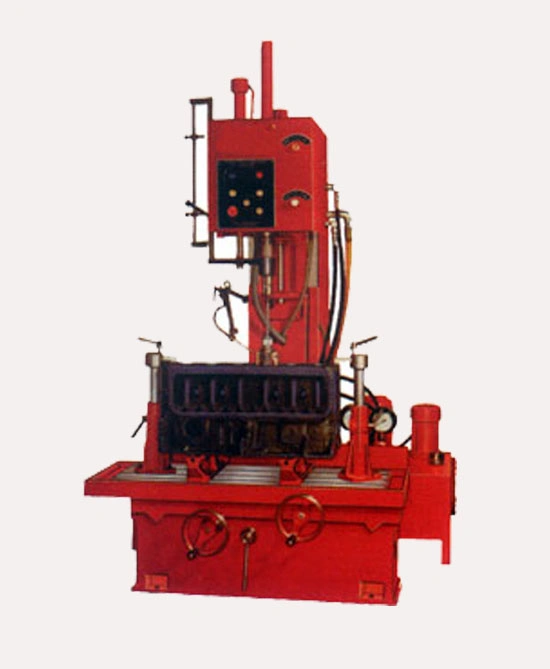
Source: Pathak official website
https://www.pathak.in/product/vertical-honing-machine/
https://www.pathak.in/product/vertical-honing-machine/
| Processing Range | Diameter: Up to ⌀200 mm Length: Not indicated on website |
|---|---|
| Stroke length (mm) | 50 mm to 400 mm (0.16 m/min) |
| Equipment Dimensions | Not indicated on website |
| Automatic Measurement Function | Not indicated on website |
| Sizing Function | Not indicated on website |
| Power Specifications | Not indicated on website |
| Manufacturer Name | Pathak Industries |
A cost-conscious Indian-made model for heavy work
The PVH-200 supports diameters of up to ⌀200 mm, has a stroke length of 400 mm, and its rpm is adjustable. It has a simple structure that is resistant to breakage, so it is suited for doing heavy work involving large amounts of force, like reboring cylinders for construction machinery or large commercial vehicles. It is also manufactured in India, which makes it an easy machine to choose from a cost perspective, as well.
List of vertical multi-spindle honing machines (for mass production or automated lines)
FS Series「Standard」

Source: Fuji Honing official website
https://www.fujihoning.co.jp/en/product_fs.html
https://www.fujihoning.co.jp/en/product_fs.html
| Processing Range | Diameter: ⌀1.8 to 50 mm Length: Not indicated on website |
|---|---|
| Stroke length (mm) | 300 mm |
| Equipment Dimensions | H: Not indicated on website W: 1,600 mm D: 700 mm |
| Automatic Measurement Function | Yes |
| Sizing Function | Not indicated on website |
| Power Specifications | Not indicated on website |
| Manufacturer Name | Fuji Honing |
A compact model with IoT monitoring and a multi-spindle design
This model has a compact design, measuring just 1,600 mm wide by 700 mm deep, but its multi-spindle design enables it to process multiple components simultaneously. The machine's operating status can be monitored at all times via the IoT, and it can be combined with a gantry loader for use in automated lines.
「ProductionHone」

Source: Delapena official website
https://delapena.co.uk/honing-machines/
https://delapena.co.uk/honing-machines/
| Processing Range | Diameter: ⌀1.14 to 80 mm Length: Not indicated on website |
|---|---|
| Stroke length (mm) | 3 to 320 mm (1 to 25 m/min) |
| Equipment Dimensions | H: 1,790 mm W: 1,780 mm D: 1,000 mm |
| Automatic Measurement Function | Yes |
| Sizing Function | Yes |
| Power Specifications | Three phase 380 to 415 V, 50 Hz |
| Manufacturer Name | Delapena |
A machine specialized for mass production, with automatic compensation and automatic tool switching functions
The ProductionHone automatically measures dimensions while processing and performs any necessary compensation, which makes it easy to produce consistent precision without human involvement. It can automatically switch between tools set up for it, which helps reduce the workload involved in set-up changes even in mass production lines with high product mixes. There is also a palletizer, so while the machine is working on one workpiece, the next workpiece can be readied for processing, boosting efficiency.
Vertical honing machines - Frequently Asked Questions
Q. Are there any points to be careful about when it comes to creating blind holes (holes with bottoms) using a vertical honing machine?
Care must be taken to removing cuttings and selecting the right dedicated tool. With verticals, metal debris tends to collect within the hole due to gravity, and honing while there is debris in the hole can affect precision. It is important to use coolant to blow any debris up and away, and to select a tool that is good at eliminating debris.
Q. What can I do if the ceiling isn't high enough?
Consider either building a pit, which lowers the floor, or going with a space-saving model which has less overall height. These are your two main options if you are unable to reserve enough overhead space to withdraw the spindle. If making changes to your factory is not feasible, it would be more practical to select a model that fits your installation environment from the very start.
Installing a vertical honing machine is making an investment aligned with your company's objectives
Vertical honing machines can be broadly divided into two types. There are vertical honing machines for dealing with the deformation that large components, such as construction machine hydraulic cylinders, suffer due to their own weight, and vertical honing machines for gantry automation and space-saving for small components, such as connecting rods. Which of these fits your usage needs determines the kind of model you should choose. First, it's important to clarify what exact challenges your worksite faces. Then, it's important to have the mentality that what you're doing is investing in a machine that matches your business objectives.
Device capabilities and manufacturer support requirements vary from business to business, differing for precision components, large components and heavy industry, and component repair and processing.
This site has carefully selected honing machines that match different business types and issues and can help companies reduce their dependence on individual operators, so please use it to assist in your comparison and deliberation efforts.
[Advertisement]
Top Three Honing Machines
That Free You from Reliance on Individual Operators
Top Three Honing Machines
That Free You from Reliance on Individual Operators
BS-VI standards and growing EV demand are driving unprecedented needs for precision machining.
While the "overseas components + local assembly" model keeps initial costs low, design mismatches and unclear accountability create long-term risks.
Integrated management from design to assembly ensures consistent machining accuracy regardless of operator, minimizing material loss, accelerating ROI, and building the foundation for global trust.
Advertiser Disclosure:
We receive compensation from some of the companies listed below.This compensation may affect which companies are included and the order in which they appear.
For
precision component suppliers
precision component suppliers
G Series
NISSIN ProSOL
NISSIN ProSOL
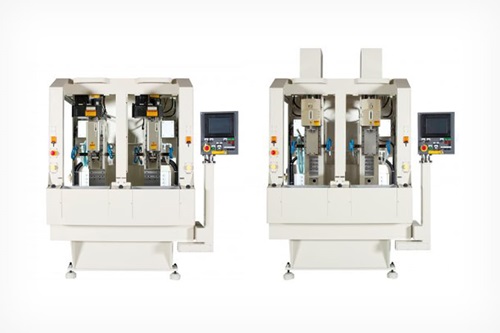
Source: NISSIN ProSOL official website https://mktg.nissin-mfg.co.jp/product/gseries/
This honing machine synchronizes stroke and stone expansion in 0.01 μm increments, enabling precision honing of holes as small as 3 mm in diameter and 80 mm deep, even in hard materials.
Automatic electronic control and made-to-order jigs reproduce the techniques of veteran operators.
These honing machines eliminate deviations in the manufacturing of precision components such as control valves while also reducing personnel costs.
| Bore Diameter |
⌀3~⌀100 |
|---|---|
| Workpiece Length |
130mm |
| Spindle Stroke Length |
Max. 300mm |
Main Applications
Gears / Connecting rods / Hydraulic valves, etc.
For
large components and heavy industry
large components and heavy industry
VL Series
Nagel
Nagel
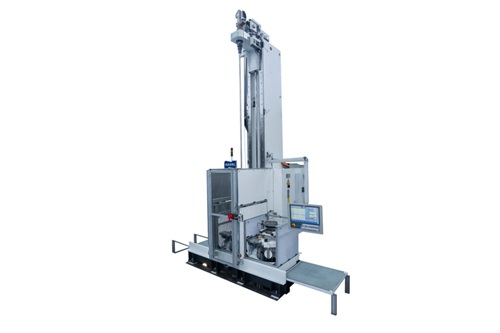
Source: Nagel official website https://nagel.com/en/products/honing/honing-machines/tube/
Machine height can be reduced through pit installation, reducing the footprint and using less volumetric space. It also makes it easy to mount and unmounts heavy objects such as engine blocks, reducing the operation workload.
They can even cut the large machining allowances unique to heavy industry in short amounts of time.
| Bore Diameter |
~⌀350 |
|---|---|
| Workpiece Length |
3,800mm |
| Spindle Stroke Length |
Not specified on official website |
Main Applications
Long pipes and tubes / Piston rods / Heavy workpieces / Exterior diameter processing, etc.
For
parts repairs and processing-on-consignment
parts repairs and processing-on-consignment
SV Series
Sunnen
Sunnen
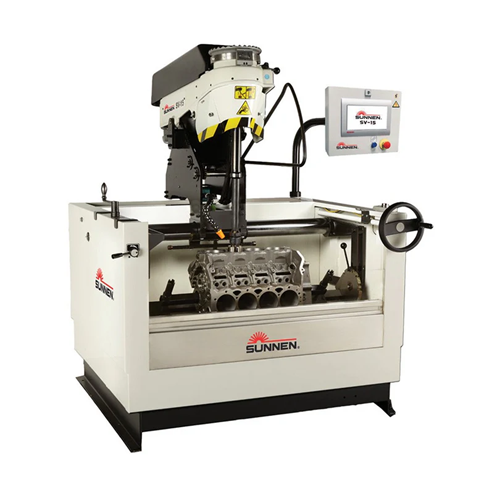
Source: Sunnen official website https://sunnen.com/products/sv-15-vertical-honing-machine
A graph showing the status of the hole being honed is displayed on-screen, in real time. This makes it easy to visually understand where the workpiece is and how it is warped, accelerating repair decisions.
These systems can store up to 100 processing settings at any time. They can also be backed up via USB, so even for small-lot, high-mix jobs, you can instantly reproduce the same processing as in previous jobs. They also shorten set-up times.
| Bore Diameter |
~⌀203 |
|---|---|
| Workpiece Length |
279mm |
| Spindle Stroke Length |
~225mm |
Main Applications
Engine blocks, etc.