
Advanced Honing Navigator │ Choose the Ideal Honing Machine » Honing machine applications » Honing Machine for Cylinder
Honing Machine for Cylinder
Contents
show more
India is the world's largest motorcycle manufacturing country*, and its automobile and construction machinery markets are also growing. This market expansion is bringing with it demands for even higher levels of quality. This page explains how to choose honing machines that can be used to perform steady and consistent cylinder processing and to improve yields.
* Source: MarkLines website (information current as of March 2026)(https://www.marklines.com/ja/report/rep2961_202601)
4 Key Specifications For Cylinder Honing
If you chose a machine based on initial cost alone, you could find yourself facing ballooning total costs due to poor precision and operation rates. Here are the four specifications you should look out for when building a stable mass production system that generates greater profit.
1. Sizing Function (measurement method) Precision and Automation Level
One of the important things when performing honing is the accuracy of the sizing function, which measures interior diameters while processing is in progress and stops the machine when the target dimensions have been reached. Some models support in-process measurement using an air gauge, while others automatically stop when the set dimension value has been reached. The advantage of these functions is that they prevent dimensional defects and non-conformance due to over-cutting. These machines make it easy to achieve the same dimensions and precision, no matter who is operating the machine, so they also help eliminate dependence on specific operators.
2. Honing Stone Expansion (feed) Control Method
There are two types of honing stone expansion: hydraulic and servo motor. Hydraulic machines have lower initial costs, and they are well-suited to workplaces where processing conditions are relatively fixed. With servo motor-controlled machines, feed can be replicated easily through numerical input, so these machines are well-suited to mass production sites where the focus is on dimensional stability and improved yield. The more your interest lies in eliminating dependence on specific operators, the better a servo-controlled machine is for you.
3. Cross-Hatching Angle and Reproducibility
Cross-hatch angles are the deciding factor in how well cylinders hold oil, and they are determined by machine rotation speed and stroke speed. With CNC machines, both of these are controlled numerically, which makes it possible to reliably reproduce finished surfaces that prevent piston wear. The ability to consistently produce high-quality products will improve your international competitiveness.
4. Suitability for India's Harsh Voltage Fluctuations and Dust
Indian manufacturing sites use three phase, 415 V power, and their voltage fluctuations and dust invite equipment problems. When selecting a honing machine, it is vital that you check if it is conformant with three phase 415 V power and if it supports noise suppression stabilizers.
Machines with countermeasures for dealing with these problems can reduce the risk of line downtime caused by circuit board failures or voltage problems, maintaining stable operation.
Key Points to Check with Manufacturers
before Purchasing a Machine
Before you install a machine, it's important to confirm not only its mechanical performance capabilities but also the manufacturer's support system.
- Does the company have any service sites in India?
- Does the company have a local inventory of spare parts?
- Does the company have licensed distributors?
- Does the company offer test cutting (demo processing)?
- Can you bring in actual workpieces (cast iron or aluminum cylinders)?
- Does the company offer training support for site operators?
If you choose a machine based purely on price, you run the risk of not being able to buy replacement parts or receive technical support when the machine suffers a failure, which can lead to line downtime or quality defects. If you buy a machine made by an overseas manufacturer via a proper sales channels, it's likely that the manufacturer will have local sites and a local support system, which makes it easy to maintain steady operation. This can actually cut total costs.
This site presents a carefully selected list of honing machines available in India, categorized by the business sector they are best suited for, with the aim of eliminating the problem of reliance on the skills of individual operators. It also presents the support systems of each manufacturer, so please use it in your comparison and deliberations.
List of cylinder honing machines
Cylinder Honing Machine "LEV300-L"
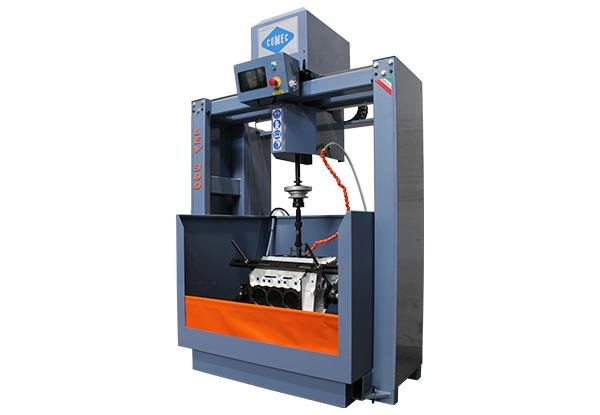
Source: Walter Krupp official website
https://walter-krupp.com/p/cylinder-honing-machine-lev300-l-puk573ui0/
https://walter-krupp.com/p/cylinder-honing-machine-lev300-l-puk573ui0/
| Processing Range | Not indicated on website |
|---|---|
| Stroke length (mm) | Not indicated on website |
| Equipment Dimensions | Not indicated on website |
| Automatic Measurement Function | Not indicated on website |
| Sizing Function | Not indicated on website |
| Power Specifications | Not indicated on website |
| Manufacturer Name | Walter Krupp* |
*Walter Krupp is not a manufacturer, but a dealer with sites in India that handles honing machines made by the Italian manufacturer Comec.
A model for high-mix, low-volume processing, such as engine repair and refurbishing
This honing machine excels at precision finishing of the interior diameters of engine cylinder blocks and similar workpieces. It is a good fit for worksites that require a high level of precision in their cylinder interior finishing, such as engine repair and engine refurbishing shops. In high-mix, low-volume processing, they also help reduce the amount of deviation in finish quality due to differences in operator experience.
Powertrain Hone Series "PT 600"
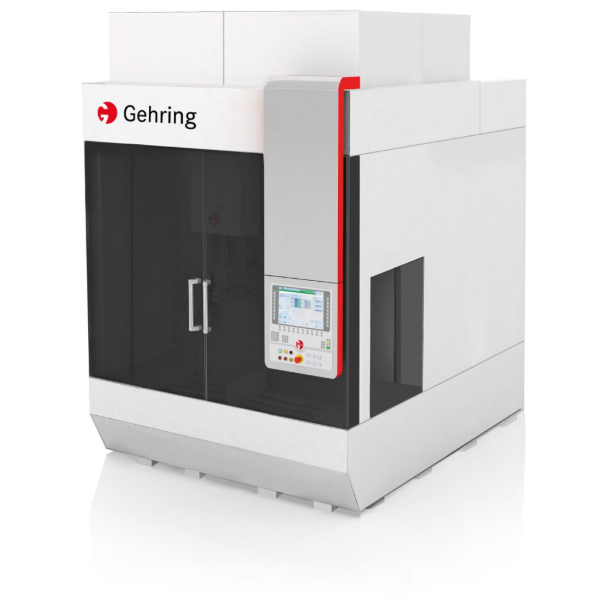
Source: Gehring official website
https://gehring-group.com/en/honing/honing-machines/powertrainhone/
https://gehring-group.com/en/honing/honing-machines/powertrainhone/
| Processing Range | Diameter: ⌀68 mm to ⌀105 mm |
|---|---|
| Stroke length (mm) | 600 mm (40 m/min) |
| Equipment Dimensions | Not indicated on website |
| Automatic Measurement Function | Yes (EMZ-F in-process measurement system) |
| Sizing Function | Yes (automatic tool expansion and dimension cut-off accuracy of approx. 10 μm) |
| Power Specifications | Not indicated on website |
| Manufacturer Name | Gehring |
A model for motorcycle and automobile mass production processing lines
As you might guess from the powertrain hone series name, this series is specialized for processing engine cylinder blocks and cylinder liners. It meets the advanced requirements of engine designs, such as thermal spray coating cutting and form honing. It aids in improving yields on motorcycle and automobile mass production lines.
Large Production Machine
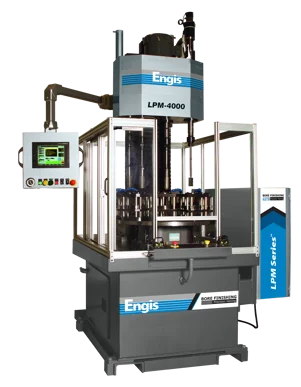
Source: Engis official website
https://www.engis.com/bore-finishing-machines
https://www.engis.com/bore-finishing-machines
| Processing Range | Diameter: Up to ⌀152 mm Length: Not indicated on website |
|---|---|
| Stroke length (mm) | 635 mm |
| Equipment Dimensions | Not indicated on website |
| Automatic Measurement Function | Yes |
| Sizing Function | Not indicated on website |
| Power Specifications | Not indicated on website |
| Manufacturer Name | Engis |
A model for processing multiple holes in construction machinery and farming machinery components
This model is for medium-sized and large components with hole diameters of up to 152 mm. It has four to eight spindles and uses a single-pass design that performs the entire honing process, including finishing, in a single pass. It can efficiently perform honing for multiple holes at the same time, so it shortens tact time for multi-hole processing in construction machinery components, heavy machinery components, large valves, and the like, and contributes to large-scale production.
Cylinder honing machines - Frequently Asked Questions
Q. Should different machines be used for aluminum cylinders than for cast iron cylinders?
Using different machines is not always necessary. However, the honing stones (polishing material) and processing conditions differ between aluminum cylinders and cast iron cylinders, so if you plan to process both, we recommend selecting a CNC machine. With a CNC machine, you can use programs to manage different rotation speeds, feed speeds, honing stone pressure, and the like for different materials, producing consistent processing quality even when working with different materials.
Q. Can India's voltage fluctuations lead to CNC machine breakage?
If you choose a machine that is not designed to deal with voltage fluctuations, you run the risk of breakage. Many global manufacturers use surge protection mechanisms and stabilizers in the machines they offer in India, so check with the manufacturer before choosing a machine.
The quality of cylinder processing will be the key to building the reputation of India's manufacturing industry
Even within cylinder processing, the machine you need will depend on your specific application, ranging from general-purpose machines for repair use to high-speed machines for automobile component mass production. One thing that affects them all, though, is that India has entered the stage in which guaranteeing quality through mechanical performance is vital to survive in India's growing market.
This site presents carefully selected, genuine machines by manufacturers who manage everything from design to assembly themselves. These machines are designed to tackle the challenges faced by businesses, whether it is precision component processing, large heavy industry work, repair work, or processing-on-consignment. Please see the following article for more information.
Top Three Honing Machines
That Free You from Reliance on Individual Operators
That Free You from Reliance on Individual Operators
BS-VI standards and growing EV demand are driving unprecedented needs for precision machining.
While the "overseas components + local assembly" model keeps initial costs low, design mismatches and unclear accountability create long-term risks.
Integrated management from design to assembly ensures consistent machining accuracy regardless of operator, minimizing material loss, accelerating ROI, and building the foundation for global trust.
For
precision component suppliers
precision component suppliers
G Series
NISSIN ProSOL
NISSIN ProSOL
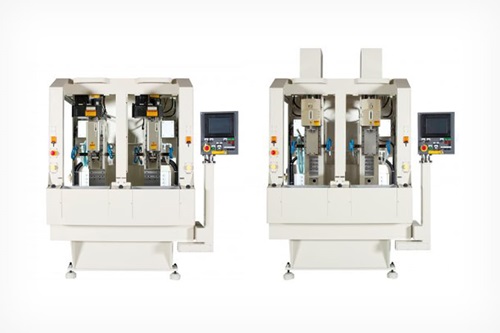
Source: NISSIN ProSOL official website https://mktg.nissin-mfg.co.jp/product/gseries/
This honing machine synchronizes stroke and stone expansion in 0.01 μm increments, enabling precision honing of holes as small as 3 mm in diameter and 80 mm deep, even in hard materials.
Automatic electronic control and made-to-order jigs reproduce the techniques of veteran operators.
These honing machines eliminate deviations in the manufacturing of precision components such as control valves while also reducing personnel costs.
| Bore Diameter |
⌀3~⌀100 |
|---|---|
| Workpiece Length |
130mm |
| Spindle Stroke Length |
Max. 300mm |
Main Applications
Gears / Connecting rods / Hydraulic valves, etc.
For
large components and heavy industry
large components and heavy industry
VL Series
Nagel
Nagel
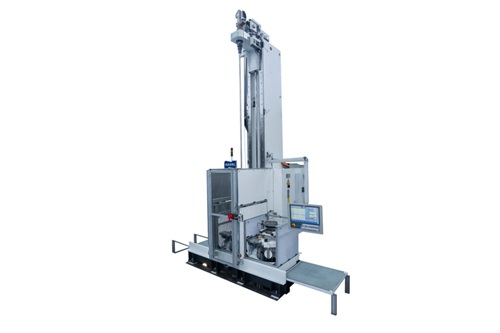
Source: Nagel official website https://nagel.com/en/products/honing/honing-machines/tube/
Machine height can be reduced through pit installation, reducing the footprint and using less volumetric space. It also makes it easy to mount and unmounts heavy objects such as engine blocks, reducing the operation workload.
They can even cut the large machining allowances unique to heavy industry in short amounts of time.
| Bore Diameter |
~⌀350 |
|---|---|
| Workpiece Length |
3,800mm |
| Spindle Stroke Length |
Not specified on official website |
Main Applications
Long pipes and tubes / Piston rods / Heavy workpieces / Exterior diameter processing, etc.
For
parts repairs and processing-on-consignment
parts repairs and processing-on-consignment
SV Series
Sunnen
Sunnen
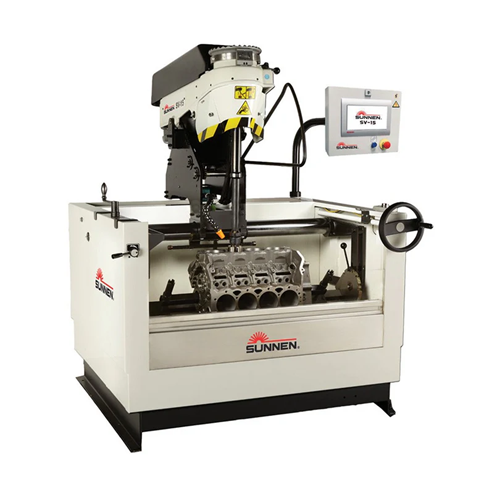
Source: Sunnen official website https://sunnen.com/products/sv-15-vertical-honing-machine
A graph showing the status of the hole being honed is displayed on-screen, in real time. This makes it easy to visually understand where the workpiece is and how it is warped, accelerating repair decisions.
These systems can store up to 100 processing settings at any time. They can also be backed up via USB, so even for small-lot, high-mix jobs, you can instantly reproduce the same processing as in previous jobs. They also shorten set-up times.
| Bore Diameter |
~⌀203 |
|---|---|
| Workpiece Length |
279mm |
| Spindle Stroke Length |
~225mm |
Main Applications
Engine blocks, etc.