
Advanced Honing Navigator │ Choose the Ideal Honing Machine » What is honing machine » Honing Machine Working
Honing Machine Working
Contents
show more
Honing machines are machine tools that perform polishing by rotating and reciprocally moving a honing stone. This page explains the fundamentals of how they work, how processing is performed, how they improve precision and quality, honing stone expansion methods, and more.
The basic mechanisms of honing machines
One of the notable features of honing machines is that their spindle rotates while moving reciprocally (up and down or back and forth) at the same time. They combine these two movements to produce uniform grid-like patterns (cross-hatching). This crosshatching keeps hold of oil, helping reduce friction heat during processing.
How honing machines tool diameters are expanded
Honing machines insert multiple honing stones arranged in a circle into a hole, and then a wedge within the tool is used to push the honing stones radially outward to perform cutting.
Instead of securing a blade in place and forcibly cutting away material, they apply constant pressure to the honing stones. This method is called “fixed pressure expansion.” They perform “profile machining,” in which cutting is performed a little at a time, starting with narrow areas or protrusions, which is why they produce a high-quality finish.
How do boring and honing differ?
Boring and honing are often confused, but both play clearly different roles. Honing is used for precision finishing, while boring is used for rough cutting. The technique that is used depends on the objective of the processing. The table below provides a summary.
| Processing Method | How Cutting Is Performed | Roles and Objectives |
|---|---|---|
| Boring | A fixed blade is used for cutting (forced cutting) | Straightening curved or off-center holes (rough cutting/shaping) |
| Honing | Honing stones are pressed against the interior diameter, widening the hole (fixed pressure expansion, profile machining) | Improving micron-level circularity (roundness) (final finishing) |
Why companies choose honing machines
Honing machines are used for finishing automotive components and precision machinery primarily for the following two reasons.
To ensure accurate circularity and cylindricality
In honing machines, honing stone rotate while moving reciprocally, so they level out minute protrusions and indentations in the interior walls of cylinders and fix shape problems such as tapering and barrel shapes. Honing can be used to make micron-level circularity and cylindricality adjustments which are difficult with other processing methods.
To improve lubricant retention
The cross-hatched patterns that can be created during processing function as “lubricant reservoirs” that hold lubricant. This lubricant retention is one of the strengths of honing machines. If you use an internal grinder that simply rotates in place and produces a mirror finish, the surface will not be able to hold enough lubricant, resulting in friction and the possibility of seizing.
Differences in honing machine expansion methods
The key to honing is which expansion method to use—that is, how the honing stones are spread. The differences between the methods affect processing precision and yield.
| Expansion Method | Control Accuracy (Dimensional, Circularity) | Main Uses and Targets in the Indian Market |
|---|---|---|
| Manual | Low (relies operator feel and intuition) |
[Single-shot or low-volume processing] Small local motorcycle repair shops, local engine rebuilders, etc. |
| Hydraulic | Medium (affected by oil temperature and environment) |
[General purpose mass production processing] Small and medium-sized component manufacturers, medium-sized auto repair shops, etc. |
| Servo motor | High (digitally controlled) |
[Ultra-high-precision, high-volume production] High-end EV components, aerospace components, Tier 1 suppliers, etc. |
How manual expansion works
Operators manually operate handles or dials to press the wedge into the interior and expand the honing stones. The advantages of machines which use this method are that they have a low initial cost and their structures are simple, so they’re easy to repair.
However, the amount of pressure that is applied is determined by the operator’s manual feel, so processing with these machines has the disadvantages of being more likely to produce results with inconsistent cross-hatching depth and dimensions and with a higher risk of defects.
How hydraulic expansion works
Hydraulic machines use oil pressure from a hydraulic pump to expand the honing stones. Their advantages are that they apply consistent pressure so processing can be performed more quickly. This makes them well-suited to medium-volume production.
However, in India’s working environments, with their extreme heat and long continuous operation hours, the oil temperature can rise, and when that happens, the viscosity of the oil changes. This causes the expansion pressure to change, which can make it more likely for dimensional deviations to occur.
How servo motor expansion works
In servo motor machines, electrical signals precisely control the servo motors that expand the honing stones. You can see, in real-time, quantitative data such as how many microns the honing stones have just widened or how much torque is being applied to the workpiece during processing.
These devices don’t rely on the intuition of experienced operators, so one of the advantages of these machines is that even operators with little experience can produce stable and consistent results. They also help eliminate management risks such as labor shortages or defects.
The basic parts that make up honing machines
Honing machines are made up of the following basic parts.
- Spindle
- Honing head (mandrel)
- Honing stones
- Honing oil (coolant) system
- Coolant (grinding fluid) system
- Measurement device (in-process gauge, etc.)
The spindle is part of the fundamental core of the machine, while honing stones are consumable supplies. While each machine’s basic structure is the same, the expansion methods used for honing stones (manual, hydraulic, servo motor) have a major impact on the machine’s performance and price.
The honing oil (coolant) washes the honing stones, keeping them from becoming clogged, while also cooling them down to prevent quality deterioration due to friction heat. If the oil is of poor quality, then even the best machine may struggle with circularity and produce poor quality results. This can result in defects and harm your company’s bottom line.
Picking the right honing machine based on an understanding of how they work
Honing machines are machines that combine rotational and reciprocal motion to finish the interiors of holes with micron-level precision. Their quality and price are significantly affected by the honing stone expansion method (dial, hydraulic pump, or servo motor). These methods affect their processing precision and productivity, so it’s important to pick a machine that matches your intended uses and the scale of your production work.
Device capabilities and manufacturer support requirements vary from business to business, differing for precision components, large components and heavy industry, and component repair and processing.
We have carefully selected the honing machines that are best suited to companies based on the features and challenges of their varied businesses, freeing them from needing to rely on specific operators. Please use the information on this site in your comparisons and deliberations.
Top Three Honing Machines
That Free You from Reliance on Individual Operators
That Free You from Reliance on Individual Operators
BS-VI standards and growing EV demand are driving unprecedented needs for precision machining.
While the "overseas components + local assembly" model keeps initial costs low, design mismatches and unclear accountability create long-term risks.
Integrated management from design to assembly ensures consistent machining accuracy regardless of operator, minimizing material loss, accelerating ROI, and building the foundation for global trust.
For
precision component suppliers
precision component suppliers
G Series
NISSIN ProSOL
NISSIN ProSOL
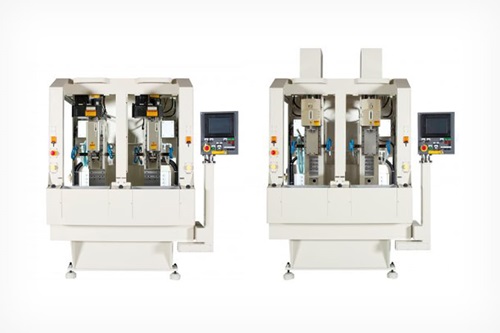
Source: NISSIN ProSOL official website https://mktg.nissin-mfg.co.jp/product/gseries/
This honing machine synchronizes stroke and stone expansion in 0.01 μm increments, enabling precision honing of holes as small as 3 mm in diameter and 80 mm deep, even in hard materials.
Automatic electronic control and made-to-order jigs reproduce the techniques of veteran operators.
These honing machines eliminate deviations in the manufacturing of precision components such as control valves while also reducing personnel costs.
| Bore Diameter |
⌀3~⌀100 |
|---|---|
| Workpiece Length |
130mm |
| Spindle Stroke Length |
Max. 300mm |
Main Applications
Gears / Connecting rods / Hydraulic valves, etc.
For
large components and heavy industry
large components and heavy industry
VL Series
Nagel
Nagel
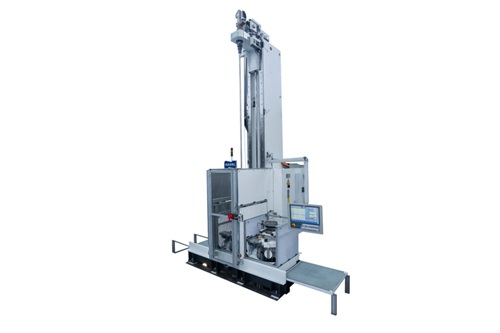
Source: Nagel official website https://nagel.com/en/products/honing/honing-machines/tube/
Machine height can be reduced through pit installation, reducing the footprint and using less volumetric space. It also makes it easy to mount and unmounts heavy objects such as engine blocks, reducing the operation workload.
They can even cut the large machining allowances unique to heavy industry in short amounts of time.
| Bore Diameter |
~⌀350 |
|---|---|
| Workpiece Length |
3,800mm |
| Spindle Stroke Length |
Not specified on official website |
Main Applications
Long pipes and tubes / Piston rods / Heavy workpieces / Exterior diameter processing, etc.
For
parts repairs and processing-on-consignment
parts repairs and processing-on-consignment
SV Series
Sunnen
Sunnen
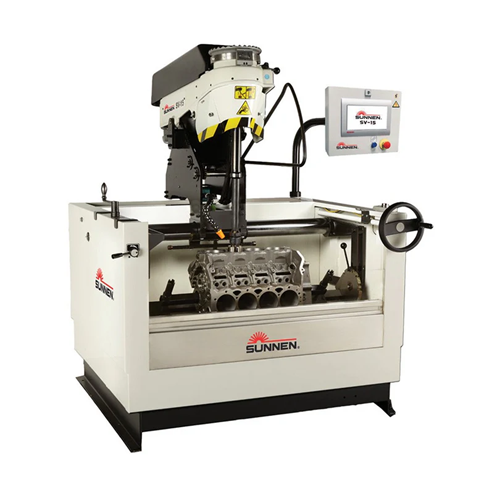
Source: Sunnen official website https://sunnen.com/products/sv-15-vertical-honing-machine
A graph showing the status of the hole being honed is displayed on-screen, in real time. This makes it easy to visually understand where the workpiece is and how it is warped, accelerating repair decisions.
These systems can store up to 100 processing settings at any time. They can also be backed up via USB, so even for small-lot, high-mix jobs, you can instantly reproduce the same processing as in previous jobs. They also shorten set-up times.
| Bore Diameter |
~⌀203 |
|---|---|
| Workpiece Length |
279mm |
| Spindle Stroke Length |
~225mm |
Main Applications
Engine blocks, etc.